
Operation Blue Skies: Contrail Avoidance at Airspace Scale
This post introduces the world's first oceanic airspace-scale contrail avoidance trial, Operation Blue Skies, starting this winter in the North Atlantic.

We're thrilled to announce Operation Blue Skies, a landmark airspace-scale contrail avoidance trial starting this winter in the North Atlantic. This short post will introduce the program and the consortium behind it.
For the past five years, we've worked to build the scientific understanding and forecasting capability to enable aircraft to reliably reduce climate-warming contrails. We've made fantastic progress by simulating contrail avoidance in commercial flight planning systems,[1] and by testing contrail avoidance on individual flights.[2]
Today we mark the next critical step in our journey — testing contrail avoidance in the real world across an entire airspace.
We're proud to be part of the UK-based consortium launching Operation Blue Skies, the world's first oceanic airspace-scale contrail avoidance trial. The trial aims to prove contrail avoidance works in real operations at large scale, with verified reductions in contrail warming.
Operation Blue Skies
Operation Blue Skies will take place in Shanwick airspace, on the eastern half of the North Atlantic. This region sees over 1,000 flights per day and accounts for approximately 5% of global contrail warming (Teoh et al. 2024).
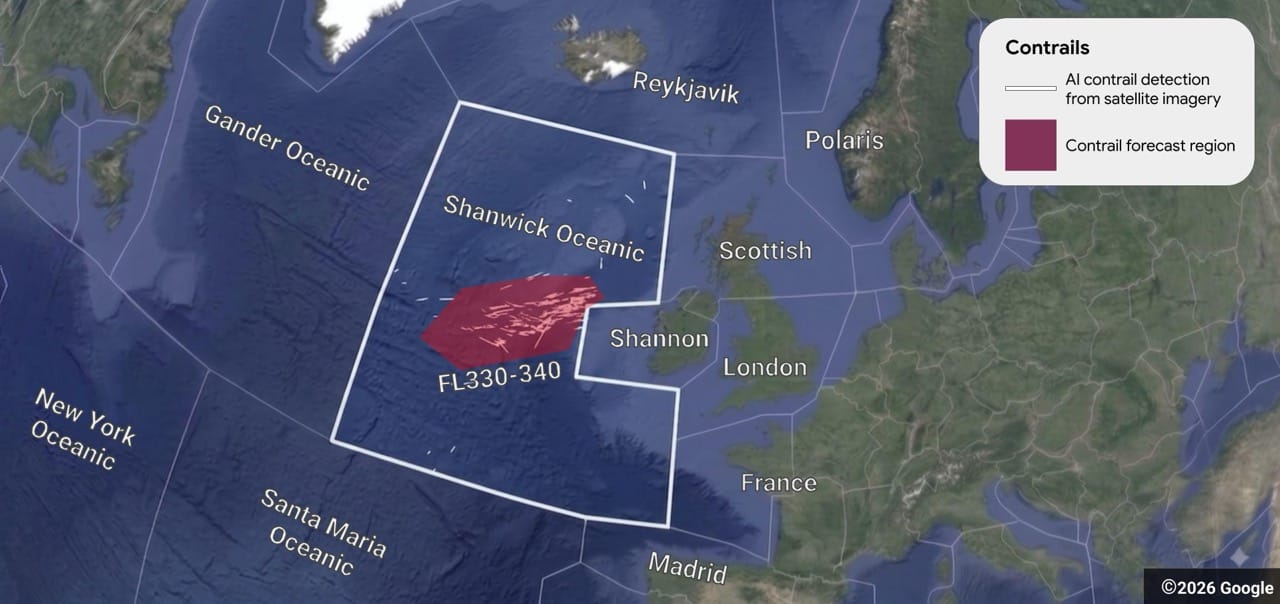
Contrail warming is most significant during the winter months in the North Atlantic (roughly November to February). Operation Blue Skies will run for 30 months, targeting two four-month trial windows during these winter months in 2026–2027 and 2027–2028.
The trials will use contrail forecasts to identify where and when interventions have the greatest potential to reduce contrail warming. The interventions will focus on minor altitude adjustments within standard flight operations, coordinated through standard air traffic control communication channels. Trial manoeuvres will take place on ~20 to 40 test days in each winter trial window during periods of lower air traffic.
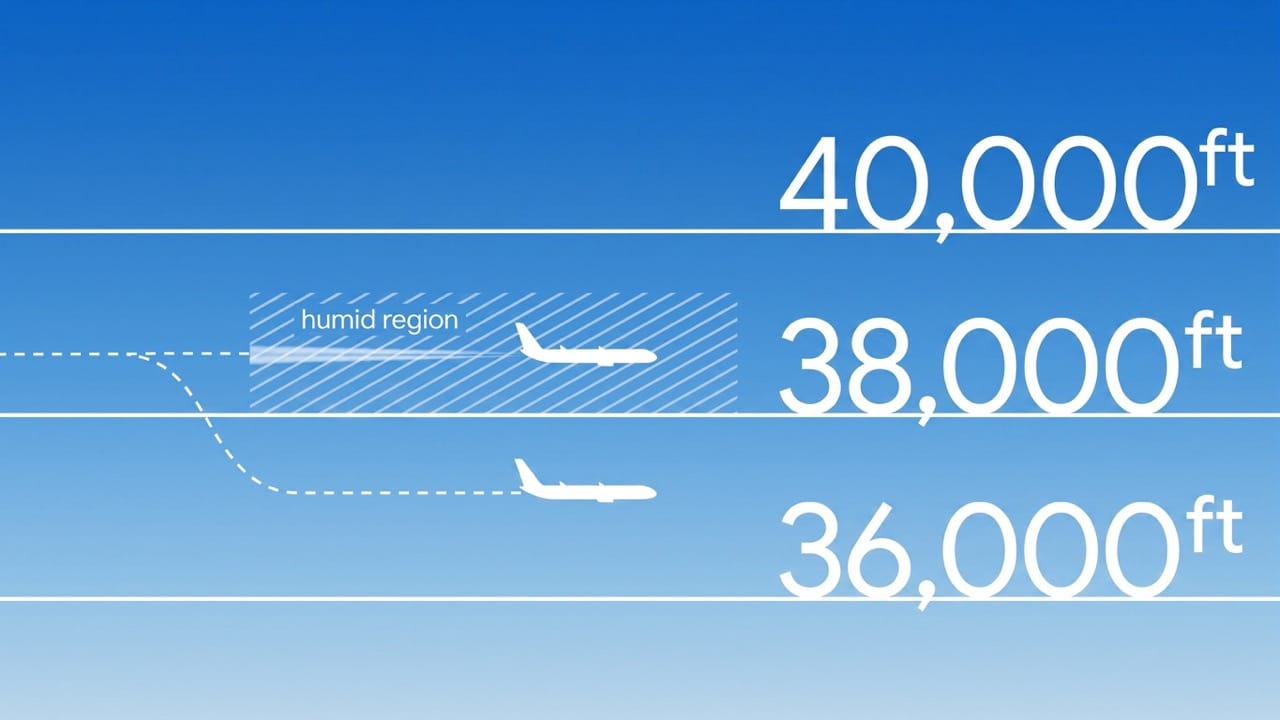
The overarching aim of the programme is to evaluate the operational feasibility and environmental benefit of adjusting commercial aircraft altitude to avoid the atmospheric conditions that let persistent, warming contrails form.
The Consortium
Operation Blue Skies brings together a powerful team of leaders in contrail science, forecast technology, and air traffic management, all based in the UK:
- Contrails.org (UK) will lead forecast assessment and integration, design trial parameters, and support data analysis.
- Google (UK) will develop models to predict and avoid warming contrails, using machine learning and satellite imaging to track and verify impact.
- NATS (the UK's leading air navigation service provider) will trial airspace operations, coordinate air traffic control, and conduct safety assessment and air traffic controller training.
- The UK Met Office will develop new UK contrail forecast capability and ensure meteorological accuracy throughout the trial.
- Imperial College London & the University of Cambridge will evaluate trial outcomes and provide independent verification of climate impact.
Operation Blue Skies is co-funded by its industry partners and the Department for Transport (DfT) through the ATI Programme, a partnership between the Aerospace Technology Institute (ATI), the Department for Business, Innovation, Science and Trade (BIST) and Innovate UK.
Trial Benefits
Most contrail avoidance trials to date, including our own, have focused on individual flights, with manoeuvres requested flight-by-flight by the airline. The impact of avoidance across many aircraft in the same airspace is still largely unexplored. The best way to close that gap is to run the experiment with an air navigation service provider, at airspace scale.
Operation Blue Skies will test contrail forecast integration into the air traffic control system rather than relying solely on routing changes originating from airline flight-planning systems. These trials provide a chance to learn how this works best in practice, and how it complements the flight-planning work already underway.
These trials will inform the technical standards for contrail forecasts built into air traffic management, and define the operational protocols managers use to act on forecasts. These trials will also provide a clearer observational signal (from satellite imagery) that avoidance manoeuvres are having the intended effect.
We look forward to working alongside the consortium partners to connect the scientific and operational pieces of the trial, ensuring Operation Blue Skies helps us understand how to implement contrail avoidance safely, measurably and at scale.
Sign up for the Notebook to follow along as the trial progresses.
Footnotes
See Martin-Frias et al. 2024 (and associated MIT Tech Review piece), and the more recent Martin-Frias et al. 2026. ↩︎
See Sonabend et al. 2024 for details on our first trial with American Airlines, or Sankar et al. 2026 (pre-print) for a pre-print describing more recent work. ↩︎